What's the Purpose of the LRO/LROC Target Observation Request web interface?
This web interface provides the opportunity for the public to suggest high-resolution targets for the Lunar Reconnaissance Orbiter Camera Narrow Angle Cameras. Users will be allowed to submit up to 5 targets per day.
Due to practical operational considerations, target suggestions that duplicate existing target requests will not be accepted for entry into the LROC target database.
This web interface provides the opportunity for the public to suggest high-resolution targets for the Lunar Reconnaissance Orbiter Camera Narrow Angle Cameras. Users will be allowed to submit up to 5 targets per day.
Due to practical operational considerations, target suggestions that duplicate existing target requests will not be accepted for entry into the LROC target database.
How to use the web interface
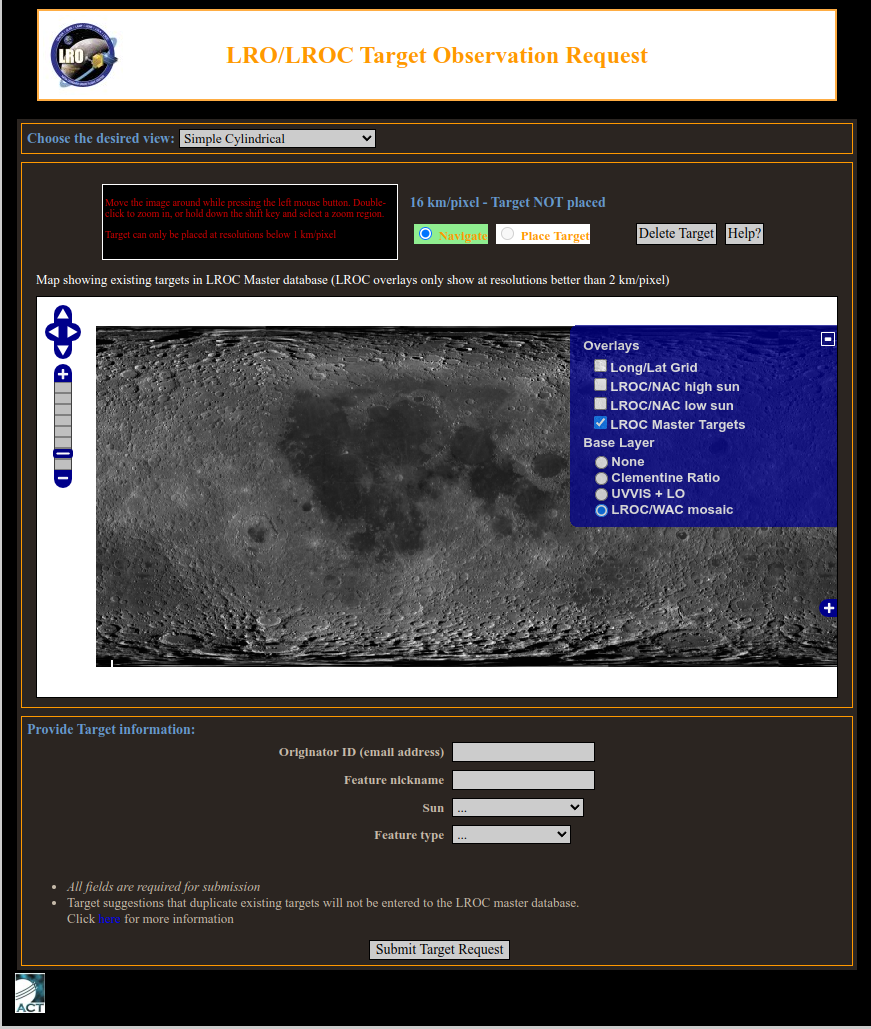
- First, pick the desired map base, the default view is a simple cylindrical projection of the whole Moon. For polar targets, you can choose to view polar stereographic views of the north and south poles.
- Next, choose which layers and options best suit your needs. Click on the larger "+" button near the upper right. You may choose between one of three different base maps, and can turn on/off different overlays (targeting bounds, longitude/latitude lines, and more).
- Once you have finalized your layer and overlays close the blue box by clicking on the "square" button in its upper right.
- Next, navigate the map to the position you desire. You can move the map around by clicking-and-dragging with your mouse. To zoom in or zoom out, you can use the "+" or "-" buttons located near the top left.
- Targeting requests already in the database are displayed as blue and green icons. Read this Lunar and Planetary Science Conference abstract for more details about the LROC Science Team's targeting strategy.
- You can also zoom in on a particular position by double clicking your mouse.
- To zoom out fully (to the starting position), click on the "globe" button (situated between the "+" and "-" buttons).
- Once you have found the location you are looking for, you can specify the area as a target by:
- First, choose the "Target Selection" option (on the right). You can only specify a targeting area if this option is toggled; the system will also NOT allow you to select a target unless you are fully zoomed in.
- Next, click on the map where you would like to place the target.
- Once you have a target area established enter target documentation. All fields must be filled to be a valid entry.
- This information is used to evaluate your target area from an operational standpoint for eventual target request acquisition.
- Once you're happy with the position of your target, you can submit your target request!
What else do I need to know?
Certain classes of targets are objects of intense interest to both NASA and the LROC Science Team, and will be imaged extensively as part of our scientific investigation. These targets are already in the request database and generally include:
- All human artifacts on the lunar surface, including the Apollo landing sites, Surveyor spacecraft, Ranger impact points, Soviet lunar probes, and S-IVB impact points and more recent impact sites.
- The notional design reference landing sites selected by NASA's Project Constellation as representative examples of human lunar exploration locations. There are 50 of these sites, carefully selected by NASA with expert lunar scientific community input because of their scientific value and high resource potential. Comprehensive imaging campaigns of these sites have been planned, and will be a primary focus of the first year of the LRO mission. You can see a list of these fifty sites (broken down into two groups of 25 sites) here and here.
- The lunar poles. During respective summers, the NACs will acquire contiguous meter-scale images of both polar regions when the shadows are minimal (well at least minimal for the poles!). From these images the LROC team will construct a complete mosaic of each pole from 85.5° (N or S) to the pole. Then, in respective winters, areas that remain illuminated will be repeatedly imaged as lighting conditions change. These multi-temporal observations will sharpen mission planners' ability to select optimal landing sites.
What happens to public target requests?
Public target requests will be added to the LROC targeting queue according to their science priority and any constraints associated with obtaining the target image(s). One thing that must be kept in mind is that Sir Isaac Newton is in the driver's seat, so targeters will have to be patient. This will be especially true during the first phase of the LRO mission, when it may be many months between target request and actual opportunity to acquire the image and subsequent posting of that image through NASA's Planetary Data System.
LROC imaging is not as simple as just taking a picture. It is a complicated process that depends upon a complex combination of celestial mechanics and operational constraints (including such factors as illumination geometry, the location of a target request in relation to other targeting requests, and LRO spacecraft operations). Please see this LPSC abstract for more details about the kind of constraints and planning generally involved in the LROC targeting process.
Although we will do our absolute best to accommodate public targeting requests, the overarching engineering and scientific goals of the LRO mission and the LROC investigation (including calibrating our instruments, supporting our friends on the LCROSS mission, collecting the scientific data to achieve our measurement requirements, and most importantly, collecting the data that NASA needs to enable future human lunar exploration and utilization) will take precedence over public targeting requests, and this will be especially true during the first year of the LRO mission. Accordingly, we can provide no guarantee that any given public target request will be imaged, nor can we provide estimates about when public target submissions will be acquired.
However, it is currently planned that the one year LRO nominal Exploration mission will be followed by a multiyear mission dedicated to science objectives. A longer mission for LRO therefore means that more public targeting requests can be accommodated.
Requestors will first receive an email at the address they provided indicating whether the target as been accepted for a position in the public targeting queue. Another email notification will be sent when your requested target has been imaged and made available.