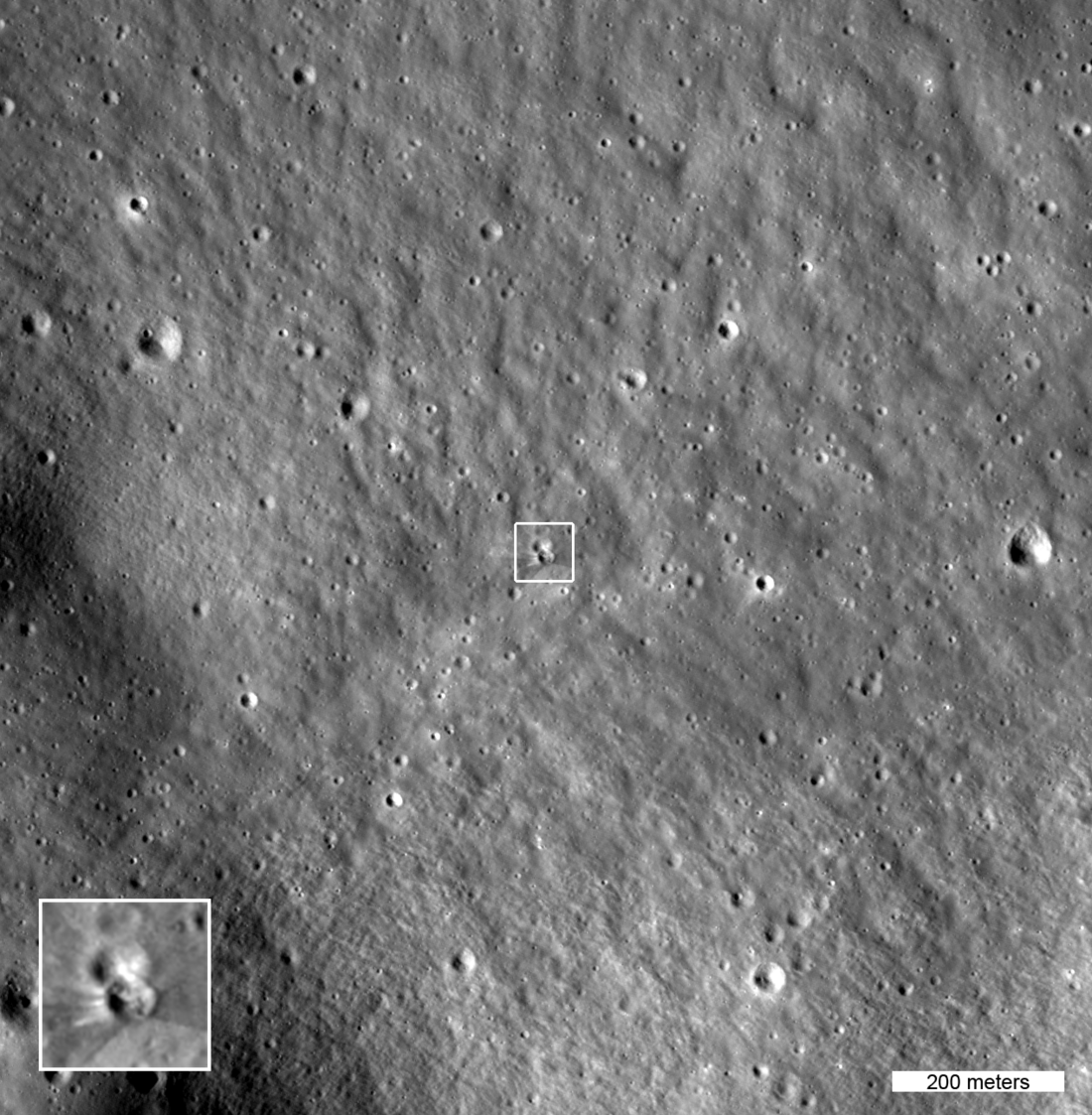
Using estimated latitude-longitude impact coordinates provided by the NASA JPL Center for Near-Earth Object Studies (CNEOS) Solar System Dynamics (SSD), the Korea Aerospace Research Institute (KARI) Korea Pathfinder Lunar Orbiter (KPLO, also known as Danuri) mission operations team planned a sequence of images to search for the newly formed impact crater. A few hours after the impact event, Danuri was commanded to point the high-resolution LUTI camera at the predicted site and acquire an image. A few hours later, the KARI team received the image and compared it to images acquired before the impact. And there it was, a new crater on the Moon!
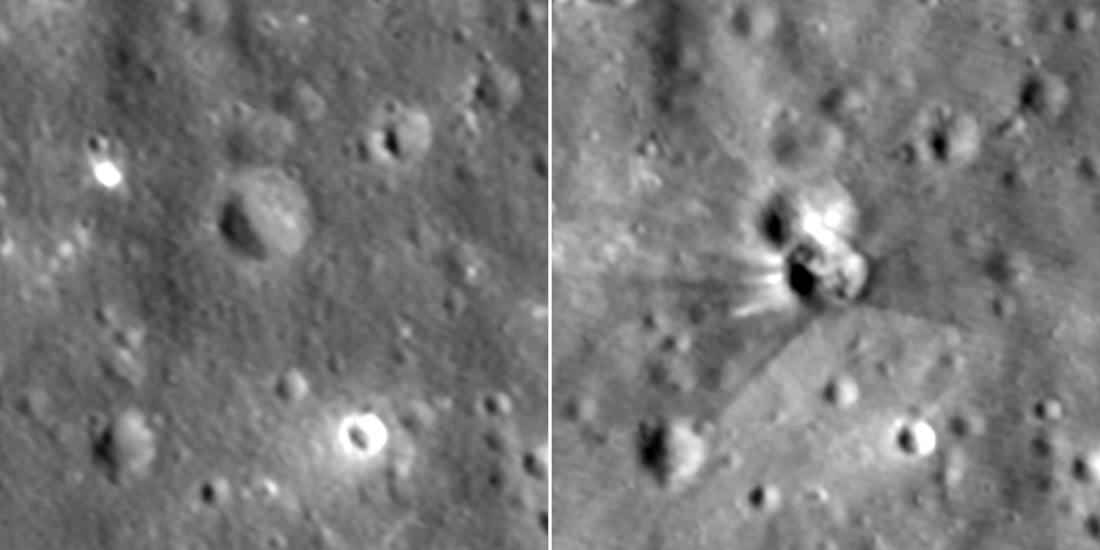
The KARI team relayed their updated coordinates, allowing the LROC team to refine their imaging sequence planned for 11 August. On the 11th, LROC acquired five images, one every 117 minutes, the time it takes to orbit the Moon. For the first image, LRO slewed 23° to the west; next, the spacecraft slewed 11° to the west; the third image required only a 4° slew, this time to the east, as the ground track had migrated past the impact site. The fourth and fifth images required east-looking slews of 17° and 28°, respectively. Thirteen and a half hours after the fifth image was acquired, LRO slewed 68° to the east to acquire an oblique view (see below).
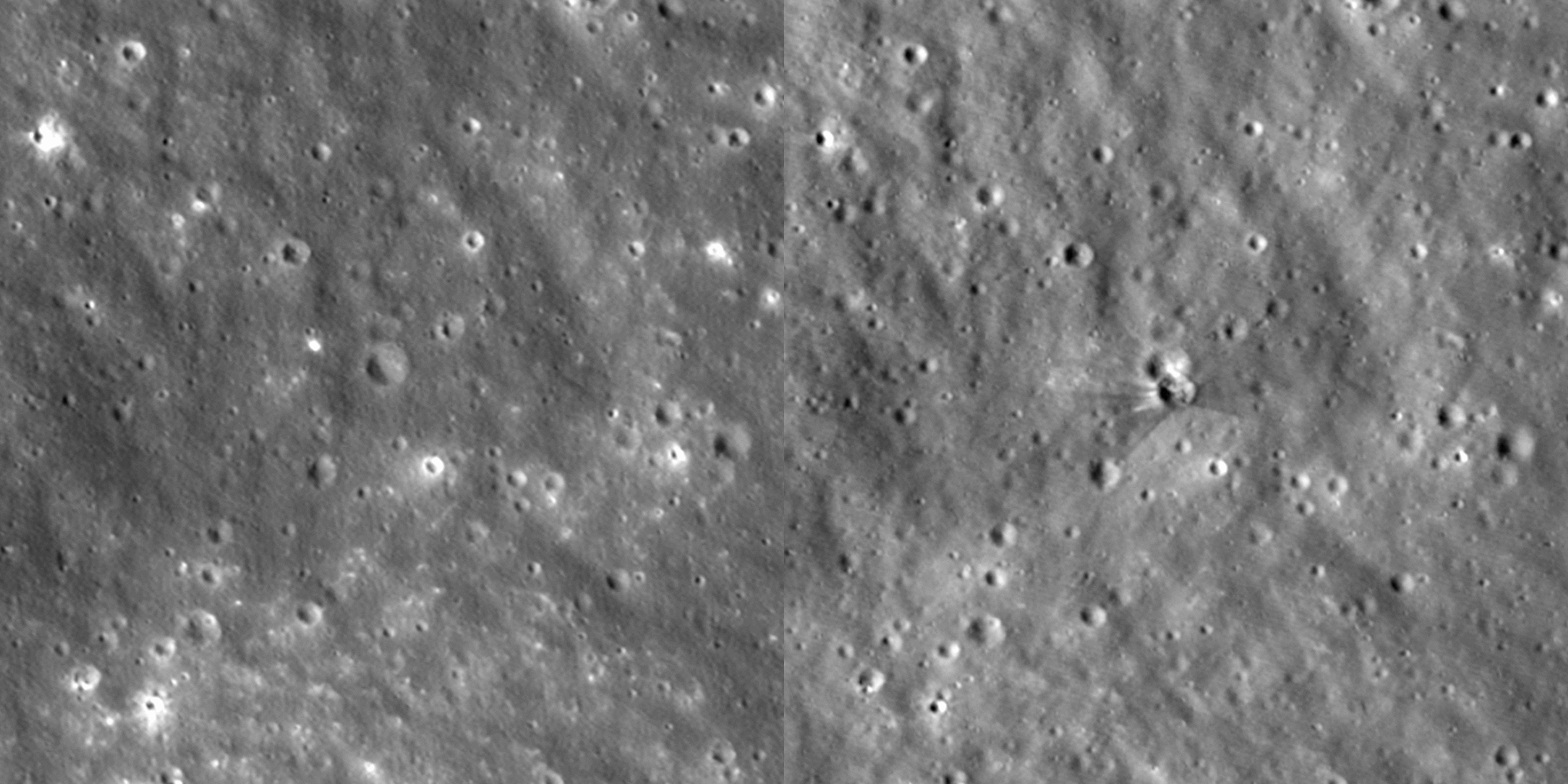
The new crater (19.4759°N, 266.7138°E, 511 meters elevation) is 18 meters in diameter and is less than 3 meters deep (constrained with a shadow measurement). The distinctive V-shaped ejecta pattern on the south side of the crater is consistent with natural impactors hitting the Moon at low angles relative to the surface. In this case, the booster impacted at about 31° from horizontal; the forbidden zone (bright area on the south side of the crater) seen here is consistent with low-angle natural impacts. Other spacecraft impacts, such as the large Apollo Saturn S-IVB stage craters, do not always follow the same rules as natural impacts. This deviation may be due to the relatively odd mass distribution within a rocket. Upon impact, most of the booster consists of empty fuel tanks with a very heavy engine at one end. The final shape of the crater and the distribution of ejecta might be affected by the orientation of the booster upon impact (i.e., heavy end down, on its side, light end down, or somewhere in between). If the heavy end hits first, perhaps the crater and ejecta behave more like a natural event.
Why the mixed dark and bright ejecta? The Moon is covered in a layer of soil, known as regolith. Over time, the top portion of the regolith is constantly bombarded by the solar wind, galactic cosmic rays, and micrometeorite impacts. These external forces tend to darken and redden the regolith to a depth of roughly 50 centimeters. As an asteroid, or rocket body, first contacts the regolith, particles are jetted out at high velocity. As the body buries itself and explodes, it throws out deeper subsurface material, forming an ejecta blanket around the crater rim. In the Falcon 9 crater, the darker, streaky material was likely derived from the mature upper 50 centimeters of the regolith. In contrast, the brighter material near the crater rim came from the deeper, immature portion of the regolith (>50 centimeters below the surface).
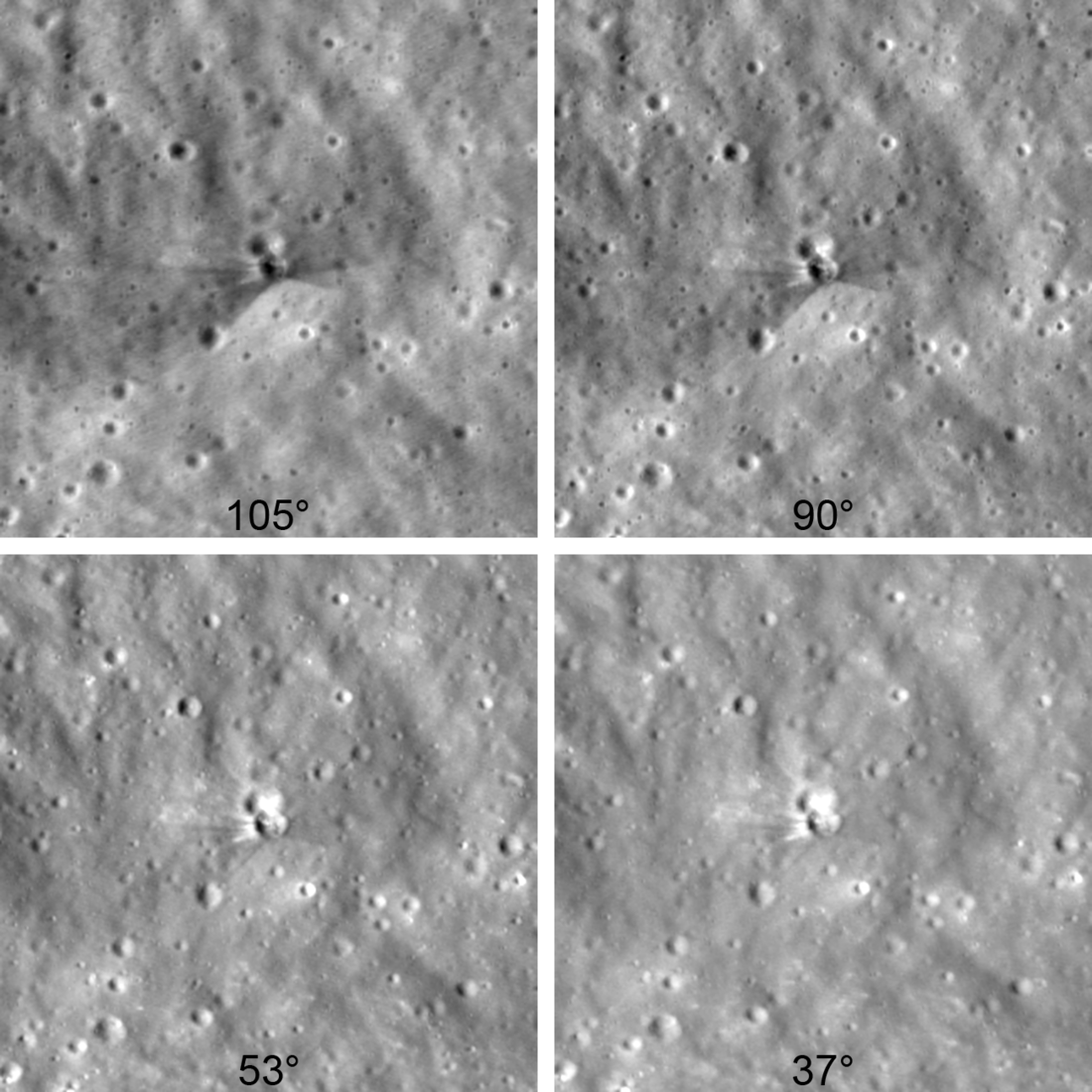
Although the Sun angle changed little (incidence angles 67° to 71°) during the image sequence, the groundtrack distance between these sequential orbits required a broad range of slew angles, resulting in a phase-angle range of 105° to 37° (phase angle is the angle between the camera boresight and the solar incidence vector). Typically, larger phase angles accentuate textural differences (roughness), while smaller phase angles highlight compositional differences. The darkened area surrounding and within the new crater, most visible in the 105° phase angle image, indicates with high certainty that the area was disturbed (roughened) during crater formation. The surface roughness is predominantly on the scale of centimeters to decimeters. Lower phase angles enhance compositional differences, and at 37° phase angle we can clearly see the extent of the brighter, less mature subsurface material which is now exposed nearby and within the crater.
The sixth, and final, image in the sequence was acquired with the largest slew angle (68°), presenting a view similar to what an astronaut would see looking out an Orion window toward the horizon. Scroll and zoom to find the Falcon 9 crater. NAC M1541154479, acquired from viewing from west to east; north is to the left; the image is about 25 kilometers wide in the center [NASA/GSFC/Intuitive Machines].
This oblique image is a great example of how the viewing angle affects what is seen. The incidence angle increased to 78° (closer to sunset), yet the shadowed area in the image seems smaller than at the lower incidence angles shown above. Note the ridge in the far background; you can only barely see the shadow beyond the crest. That is because the Sun is close to behind the camera, so shadows are hiding behind topography (the phase angle is <4°).
Related Featured Images
Rocket impacts recorded by the Apollo seismic network
Found! Apollo 16 S-IVB Impact Crater
Spacecraft-Related Coordinates - 2016 Update
Published by Mark Robinson on 18 August 2026